Showing posts with label 2001. Show all posts

Monday, August 23, 2021

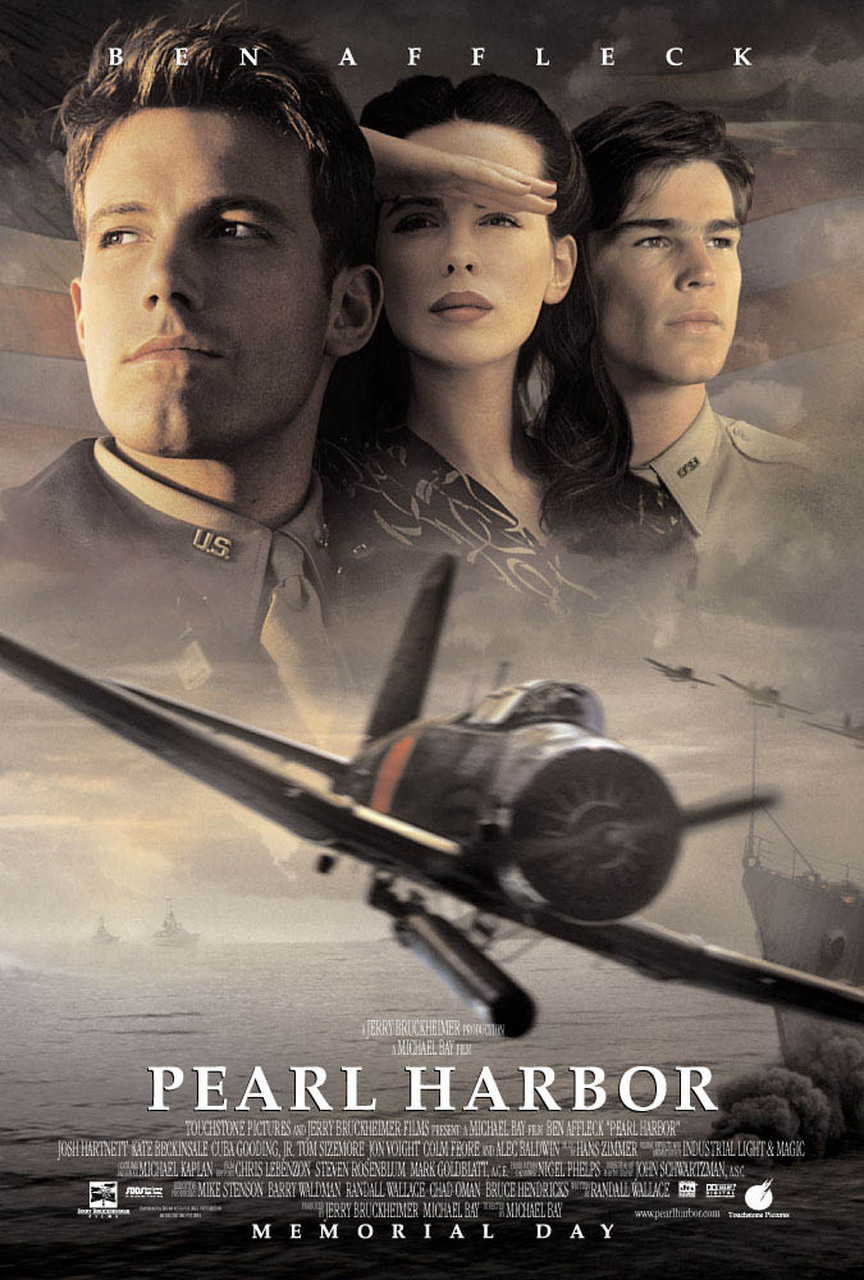
Pearl Harbor


Epic Portions


A Japanese bomber soars over the ill-fated Hawaiian harbor in the early morning hours of that infamous date in history. As it releases it's deadly weapon of destruction, the camera follows it down, a 'bomb's eye' view of it's descent into the hull of the USS Arizona. Ripping through the bulkheads like tissue paper, it comes to rest in the battleship's hull, moments later exploding, dealing a crippling blow to the unsuspecting American fleet.

This creative camerawork is one of the highlights of the exhausting middle hour of Pearl Harbor (released by Disney's Touchstone division), the latest motion picture account of the devastating events that led to the United States' involvement in World War II. Played out in real time, the attack scenes have a raw intensity, a "you are there" feel that every war film following Saving Private Ryan is now obligated to have.

Unfortunately, this thrilling yet gut-wrenching sequence is bookended by two more hours of story. The film is it's own mini-saga, an instant gratification trilogy, packing three distinct movies into one very long three-hour-plus running time.

The first hour or so provides the back story, a love triangle involving two lifelong buddies-turned-fighter pilots (Ben Affleck and Josh Hartnett) who both fall for the same beautiful Army nurse (Kate Beckinsale). This doomed romance owes a great deal to an earlier classic, From Here to Eternity. There is an intentional effort put into recreating the look and feel of, not the 1940s time period itself, but of the films of that era, with the 'aw-shucks' patriotism and 'doin' it for my girl back home' bravado. But a little of this goes, as most clichés often do, a long way. By the time the oh-so predictable plot twists are reveled (I'm giving nothing away by saying that the apparent demise of a certain character is negated by the fact of which actor is playing the role), I was giving into the un-American urge to scream "just bomb the place already!"

Following the sensory over-load of the titular tragedy, we are subjected to the built-in sequel: the subsequent "Doolittle Raid" on Tokyo. This tactic, of tacking on the requisite 'happy ending' where the American forces are victorious, is painfully obvious, albeit not entirely unjustified. This is, after all, an American film made by an American company for American audiences eager to reawaken their latent flag-waving genes.

As brought to the screen by uber-producer Jerry Bruckheimer, he-man director Michael Bay (who previously collaborated on such testosterone-fests as The Rock and Armageddon) and Braveheart scribe Randall Wallace, Pearl Harbor hopes to follow in the box office footsteps of a certain other fictionalized-romance-set-against-the-backdrop-of-a-cataclysmic-history-altering-event-epic-motion-picture-event. (You know what I'm talking about; I'll resist jumping on the bandwagon of so many who are quick to pontificate on the many similarities between the two films. I won't even invoke the "T" word here.)

Director Bay is not known for his handling of actors; he is much more at home blowing stuff up; this film is his attempt at breaking out of the 'glorified B-movie' ghetto he has created for himself. But while he is preoccupied with endless low-angle shots of our heroes in slow motion and embarrassing attempts at symbolism (let's just say that he could be arrested for desecrating a lot of flags in this movie), some fine performances do emerge.

In previous films such as Good Will Hunting and Bay's Armageddon, Ben Affleck has perfected his 'guy's guy' persona, while still maintaining enough goofy sensitivity to add to his appeal to women. As Rafe McCawley , he taps further into that 'feminine side,' fleshing out his character into a truly romanticized war hero, one you could truly "keep the home fires burning" for. And, even with having to bark such lines as "just get me in a plane!", this is his best performance to date.

Kate Beckinsale, icy before in her work in such films as The Last Days of Disco and Cold Comfort Farm, blossoms into a screen siren in here pivotal role as Evelyn Johnson. With period hair and make-up that would give Ava Gardner a run for her money, and a flawless American accent, I didn't even recognize this British actress who's most famous role to date was Jane Austin's Emma on A&E. Her role as a nurse also makes it possible to show the women behind the men in this 'man's war'... Rosie the Riveter would be proud.

Josh Hartnett plays the final point in this lover's triangle, Danny Walker. While his boyish good looks and constantly wounded demeanor make him the likely heir to the throne of Leo in the hearts and fan mags of teenage girls everywhere, he has the acting chops to be the one to watch for in the future.

The roles played by the above three actors are fictitious, but there are historical figures represented in Pearl Harbor as well. Alec Baldwin, former leading man who has now graciously moved on to such character roles, plays Colonel James H. Doolittle, the career army man behind the retaliation strike against Japan. Cuba Gooding Jr. portrays real life hero Dorie Miller, an Army cook who took to the guns to down several enemy aircraft during the raid. Japanese acting legend Mako adds quiet dignity to role of Admiral Yamamoto. And yes, underneath the rubber face, that is Jon Voight as President Franklin D. Roosevelt.

While at times rousing and jaw-dropping in it's spectacle, Pearl Harbor indulges to much in it's own self-appointed fervor. Some economy should have been applied to the storytelling, as the human aspects amount to little more then filler as we watch the clock tick down to 7:55 A.M., December 7, 1941.

Toon Talk Rating: C+
MPAA Rating: PG-13
Running Time: 183 minutes
In theaters now nationwide.

Toon Talk Trivia:

  • A fighter pilot is seen painting a familiar looking duck on the side of his plane.
  • Cuba Gooding Jr. will lend his vocal talents to the upcoming Disney animated film Home on the Range.
  • FDR has made other appearances in Disney productions, including The Hall of Presidents at the Magic Kingdom, The American Adventure at Epcot and in The Wonderful World of Disney television version of the Broadway musical Annie.


-- Originally posted May 28, 2001

Monday, May 10, 2021

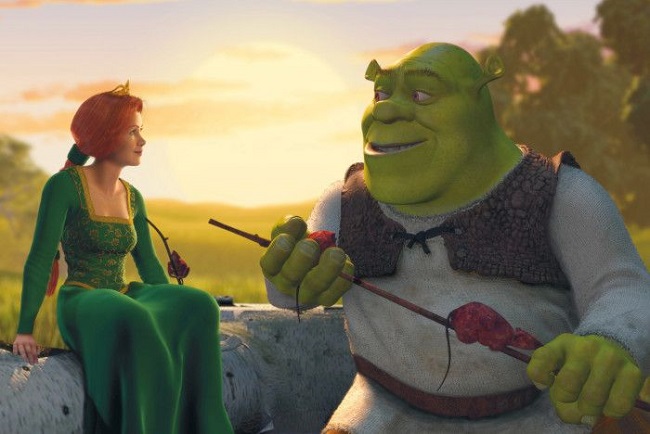
Shrek


Green With Envy

First things first: Shrek is not a Disney film. Occasionally, Toon Talk will review animated films that are not produced by Disney that are still of interest to our readers.

That said, Shrek is the latest release from DreamWorks SKG's animation division. As every movie fan knows, the SKG stands for (Steven) Spielberg, (Jeffrey) Katzenberg and (David) Geffen. These three entertainment heavyweights teamed up to form their own studio several years ago, with former Disney exec Katzenberg handling the animation arm of the studio. And, again, everyone knows the animosity between Katzenberg and Michael Eisner upon his departure from the Disney company.

Thus we come to Shrek: filled with irreverent pokes at Katzenberg's former Mouse House boss, some say it is his 'revenge' against Eisner. While the movie does have it's share of in-jokes and allusions to the classic Disney animated films (appearances by Pinocchio, Peter Pan, Snow White, et al; the evil lord's castle is run like a certain world famous theme park), it is not a wall-to-wall smear of Disney. None of the jabs are overtly mean-spirited, but they are not quite original either. We've seen these take-offs before, in everything from National Lampoon's Vacation to The Simpsons, and in most cases with better results. And for the record, most of these jokes can be seen in the trailer.


The hero of this fractured fairy tale is Shrek, a reclusive ogre voiced by Mike Myers, in a variation of the Scottish brogue he used for his "Fat Bastard" character from Austin Powers: The Spy Who Shagged Me. Shrek is quite comfortable in his swampy home, that is until his serenity is disturbed by the arrival of a wise-cracking talking donkey (Eddie Murphy, channeling Chris Rock) and hordes of dwarfs, fairies and other nursery rhyme folk. Seems that the ruler of the neighboring kingdom, the diminutive despot Lord Farquaad (John Lithgow) has issued a decree baring all magical creatures from his domain. (I guess that would make it the Non-Magic Kingdom.)

In order to rid his swamp of the pesky pixies, Shrek goes to confront Farquaad at his palace, an imposing structure with it's own queue line and turnstiles. After Shrek, WWF-style, defeats his army of soldiers, Farquaad agrees to clear out Shrek's swamp of it's unwanted squatters, but only if the ogre will rescue a certain damsel in distress, Princess Fiona (Cameron Diaz), from her prison in a nearby castle, guarded by a ferocious fire-breathing dragon.

So Shrek, with the donkey tagging along, sets out to accomplish his mission. After rescuing the fair (yet feisty) maiden, who turns out to have a secret of her own, a variation of Beauty and the Beast plays out as they make their trek back to Lord Farquaad and his plans for marrying Fiona.


In the end, there is still the proverbial happy ending. It's this schizophrenic tone to the film, trying to simultaneously send up the fantasy genre while still embracing it's tenets, that ultimately undermines the film. What Shrek is is an attempt to bring an old fashioned fairy tale into the 21st Century. The question is, do we really need that, especially in this crude-minded form?

To add that 'hip' spin to this version, we are subjected to jarringly inappropriate rock songs on the soundtrack, modern slang like "24/7" sprinkled into the dialogue, and a hero who literally burps and farts his way through the story. (Bodily fluids are the subtext here... earwax, spit, snot, even urine makes an appearance in one truly tasteless example. Welcome to the Tom Green era of movie comedy.)

The film is not totally devoid of it's own brief glimmers of wit and creativity. Funny bits such as Farquaad's interrogation of a hapless Gingerbread Man, the Magic Mirror's Dating Game-style prognostications and an expected but still humorous parody of the ubiquitous musical number (an oddly French Robin Hood introduces his Merry Men through song) do illicit laughs. And the photo-realistic computer animation, provided by DreamWorks' Pacific Data Images, creates a believable storybook landscape, although human characters still haven't been perfected enough to erase that stiff, creepy-fake look.


It's very in fashion lately to take pot-shots at Disney, and has been for some time. The difference here is that it is being done under the watch of a former Disney insider, the man who oversaw The Lion King and then watched it become the highest grossing animated film of all time, only to be unceremoniously shown the door soon after.

By turning the tried-and-true Disney fairy tale formula inside out, Katzenberg is thumbing his nose at the animation establishment for years dominated by Disney. Is it just sour grapes that Katzenberg would suffuse this rather rote storyline with such base humor in a vain attempt to produce his own blockbuster?

Toon Talk Rating: C-
MPAA Rating: PG
Running Time: 90 minutes
In theaters now nationwide.

Toon Talk Trivia:
  • Eddie Murphy played another sassy sidekick, the incomparable Mushu, in Disney's Mulan.
  • Veteran Disney voice-man Jim Cummings, best known for his current roles as both Winnie the Pooh and Tigger, lends his vocal talents to the ensemble cast of this film.
  • John Lithgow was the original actor cast for the role of Hades in Disney's Hercules.

-- Originally posted May 22, 2001
 

Monday, September 7, 2020

The Emperor's New Groove: The Ultimate Groove


Llama-Rama, Part 2 of 2

Disney's 39th animated feature The Emperor's New Groove is now available on Disney DVD in two versions: the standard one disc DVD (reviewed in Part 1 last week) and a deluxe two disc collector's edition set titled The Ultimate Groove, reviewed below.

What's the Difference?:
Disc 1 of The Ultimate Groove set is the same as the standard DVD release, without the Behind the Scenes featurettes, Deleted Scene and the Sting Music Video, which are included on Disc 2 of the set instead. Disc 1 features the full-length film, with optional audio commentary from the filmmakers, the Rascal Flats Music Video and the set-top game, "The Emperor's Got Game." Also included on Disc 1 are special DVD-ROM features, including a demo of "The Emperor's Groove Center" (QuickTime required) and exclusive on-line content only accessible through the DVD.

Disc 2 features an exhaustive collection of supplemental material that will be a treat for animation fans in general and The Emperor's New Groove fans in particular. The extras can be navigated in one of two ways: you can choose to view one of two "Get Into the Groove" features (The Studio Groove or The Animation Groove), or explore each section on your own. My recommendation is to watch the two "Groove" sections first. That way you will get a good overview of the animation process as told through the making of The Emperor's New Groove by producer Randy Fullmer and director Mark Dindal. Then you are free to roam about and check out the incidental features and galleries at your leisure. Plus, the two "Groove" sections are set up as a continuous narrative that is best viewed from beginning to end. Sections of the two "Grooves" do reappear in the individual sections, so they can be skipped at that time to go on to the new stuff.


Get Into the Groove - The Studio Groove:
In the spirit of the film it depicts, this "making of" feature is fast-paced and not without it's own degree of laughs, mostly supplied by the clips from the movie interspersed throughout as if reacting to the commentary by Fullmer and Dindal. One can also see a parallel between the two filmmakers and their two main characters. Dindal is the wild and crazy one, teasing and joking with Fullmer, who is relegated to the 'straight man' role in their little comic bits. This is typical Disney 'behind-the-scenes' goofiness, aimed more at younger children who probably wouldn't sit through this type of thing anyway. Thankfully, this silliness is brief, and mostly palatable to those who are watching this who actually want to learn how an animated film is created in this day and age. Which it accomplishes very well.

By using the making of The Emperor's New Groove, Disney here is able to depict the complete gestation of a contemporary animated film, from the first idea of the story down to the completed feature. If you have ever seen any of the earlier documentaries on the Disney animation process (such as in the film The Reluctant Dragon or on old episodes of Disneyland/The Wonderful World of Disney), you have seen how they did it back in Walt's time. While there has been more updated attempts of explaining the newer, more technologically advanced Disney 'way' (The Magic of Disney Animation tours at the Disney-MGM Studios and Disney's California Adventure theme parks, those inane Movie Surfer specials on The Disney Channel), this disc offers a very complete and comprehensive video tour of how Walt Disney Feature Animation makes films today.

Fullmer and Dindal take you through development, story meetings, the creation of layouts and backgrounds, the entire animation process, the adding of sound and music... generally how they make it all work. Again, these all have their own sections so that you can delve even deeper into how each step is performed.


The Animation Groove:
In this briefer featurette, you can watch how a particular scene (in this case, the dinner scene where Yzma and Kronk try to poison Kuzco) is created throughout the animation process with split screen comparisons, from storyboard to rough animation to clean-up animation to the final full-color product. Once you are done with these two, you can go onto the other sections of "The Secret Lab" for even more extras, such as...

Development - The Development Process:
Included in The Studio Groove, this explains how the concept for The Emperor's New Groove was developed and how it was decided that it would 'break the mold' of previous Disney animated features and be a screwball buddy comedy. We also learn that animated films are developed on two parallel paths, the story itself and the visual look of the movie.

The Research Trip: Included on the standard DVD (see Part 1).

Story Treatment:
An all text description of the story for the film. A complete waste of space as A) if you have already seen the movie, this is redundant, and B) if you haven't seen the movie, it gives away the whole plot.

Visual Development Gallery:
Includes the concept art to help the artist grasp the feel of the film, depicting the various locals featured, including Kuzco's palace, Pacha's village and Mudka's Meat Hut.

Original concept art for Kingdom of the Sun

Kingdom of the Sun:
The most disappointing aspect of this disc is that it virtually ignores the original concept of this movie, originally titled Kingdom of the Sun. If you are looking for Disney to come clean on the tumultuous early production of this film, which included defecting animators and a scrapped song score, you ain't gonna find it here. All that is left is a gallery of early concept art in which we can only attempt to glean what this film was originally going to be like.

Story and Editorial - The Story Process:
Focuses on the story department, which consists of storyboard artists and writers, who work together to create the characters and how they will tell the story.

The Pitch: See three different story pitches for the opening number, "Perfect World". We learn in the second pitch that in Kingdom of the Sun, as it was then called, Kuzco sang this song. A fascinating peek at how they 'choreograph' a Disney song and also how they will constantly re-work a scene to get it right.

Putting It Up On Reels:
Another interesting revelation: the editorial department takes the individual storyboard frames and creates a story reel, with dialogue, sound effects and music tracks added. This is done to get a feel for how the scenes are working and to get an idea of how long each scene will be before they go on to the next step of actually being animated.


Deleted and Unused Scenes:
The first deleted scene, "Practice Destruction of Pacha's Village", is included on the standard DVD (see Part 1).

"Pacha's Family": Interesting to note that Pacha's family was originally a lot bigger, with a scrappy grandpa and a surfer dude next-door-neighbor who, in typical sitcom fashion, bursts into the room unannounced and at the worst possible moments. Upon discovering the talking llama, the village throws him a welcoming party. This scene was too long, unfunny and unoriginal and didn't make it past the storyboarding phase.

"Original Kuzcotopia Ending": The original ending for the film had Kuzco building his full-size summer pad on the mountaintop neighboring Pacha's village. In the big grand opening party of Kuzcotopia, we see all the characters joining in for the fun, including the guards that were turned into animals in the final battle. The final gag has Kronk in his apron coming out of the kitchen wanting a "head count for dessert." His shoulder angel and devil pop in, with their own aprons on, and say "We got you covered!" This ending was nixed when Sting, an avid environmentalist, noted that to have Kuzco still build Kuzcotopia showed that he didn't learn anything from what had happened to him through the course of the film. It was still "socially irresponsible" and "ecologically unfriendly" for him to do so, and the scene was altered to what you see in the final film. While I can see why they made the change, it still would have been fun to see that octopus playing volleyball…

Layouts and Backgrounds - Layout and Background Departments: The layout artists are very important to animated films, as they are basically the film's art director and cinematographer combined. They prepare the work for the animators and background artists, who "create the stages where the animated characters will play."


Inside Scene Planning: This department is where all the initial drawings are first put into the computer to create the timing sheets used by the director and the animators. These sheets allow the animators to get the exact timing right for each line of dialogue, gesture, et cetera.

The Workbook Gallery:
Thumbnail sketches of the dinner scene, showing the preliminary creation of the scene, focusing on composition and camera angles.

Layout, Color Key and Background Galleries:
Examples of the best layout artwork, color keys (used to establish the color scheme for each scene) and background paintings for The Emperor's New Groove.

Animation - The Animation Process:
Learn about the three kinds of animation needed to produce a completed film: Character, or rough, animation is handled by the character lead and his/her team. They are the actors behind the pencils who draw the characters. Clean-up animators take the rough pencil drawings and, as their job title states, clean them up into a uniform look for the final product. Special effects animators handle everything that moves in the film that is not a character. For example: rain, smoke, fire, shadows and props.

Character Animation - Character Voices:
Included on the standard DVD (see Part 1).

Character Design:
Each character has there own section, with Animation Tests for the four main characters. See early rough animation for Kuzco that shows a more realistic look for him in llama form (albeit wearing a crown) and with buck teeth and spiky hair in human form.


Character Design Galleries:
See early concept drawings and sketches showing the evolution of all the characters, from the Emperor down to his lowly servants. See how at one point Pacha looked like Marlon Brando in a muumuu and how Kronk, at different stages of development, vaguely resembled Fabio and The Rock.

The most illuminating section is for the miscellaneous characters, where one can see characters that never made it to the final film, including the intriguing "Naked Guy and the Peacock." Also note what one of Mudka's Meat Hut waitresses has on her platter ... grilled flounder must be today's special. You can also see the progression of these designs through the ever changing title on the production sheets: Kingdom of the Sun, Kingdom in the Sun, The New Kingdom and finally The Emperor's New Groove.

Character Model Sheets:
Yet another gallery, this one displaying the final character model sheets for the four main characters. Model sheets are used by the clean-up animators to retain continuity for the characters, so that they look the same throughout the entire film.

CGI Props:
Included in the standard DVD (see Part 1).

Animation Production Progression: Again using the dinner scene as an example, viewers can use the 'angle' button on their remotes to toggle through the progression of the animation, from story reel to rough animation to clean-up animation to the final scene and back again. This is a nifty way to see how all the different stages of animation come together.

Putting It All Together - Ink and Paint Compositing:
The Ink and Paint Department used to actually use ink and paint to hand color each individual animation cel. Now it is done on computers as explained here.

Color Models: Yes, another gallery, this one includes five color models showing the final color schemes for Kuzco, Kuzco Llama, Pacha, Yzma and Kronk. Again, uniformity is the objective here.


Music and Sound - Creating the Music and Sound Effects:
This is the final step: after all the cleaned-up animation has been colored and combined with the background paintings and is all composited in the computer, a 35 mm print of the film is made and is ready to have the dialogue, music and sound effects added. This is done in the sound studio where it is all orchestrated to create the best mix of the three sound elements.

Sting Music Video: "My Funny Friend and Me":
Included on the standard DVD (see Part 1).

Mixing Demonstration: Using a scene from the movie (no, not the dinner scene again ... this time it's the rope bridge scene), you can isolate the dialogue, sound effect and music tracks or combine them in any way you choose by using your remote.

Publicity - Trailers and TV Spots: Includes the two theatrical trailers and three TV commercials for The Emperor's New Groove.

Posters/Ad Campaign: A gallery of the poster art and newspaper ads for the initial theatrical release of The Emperor's New Groove.

Note: The first retail shipments of both the standard and deluxe DVD editions of The Emperor's New Groove come packaged with the free CD-ROM game "Search for the Journal," based on the upcoming Walt Disney Picture Atlantis: The Lost Empire.

All in all, The Ultimate Groove is a fine, although at times overwhelming, presentation of the creation of a Disney animated film.

Toon Talk Grade: B+

Originally posted May 9, 2001

Friday, April 24, 2020

The Emperor's New Groove


Llama-Rama, Part 1 of 2

The Emperor's New Groove, Disney's 39th animated feature is now available on video and on Disney DVD in two versions: the standard one disc DVD (reviewed below) and a deluxe two disc collector's edition set titled The Ultimate Groove, which will be reviewed next week.

Set in an unnamed Latin American empire, The Emperor's New Groove introduces us to the ruler of said domain, the spoiled-rotten Emperor Kuzco (voiced by David Spade). He leads an excessively charmed life where his every whim is catered to; as his 'theme song' states, it is his "perfect world." His pampered existence is threatened by the mutinous mechanizations of his recently fired royal advisor, the devious diva Yzma (Eartha Kitt). Aided by her studly side-kick Kronk (Patrick Warburton), her attempt to poison Kuzco in order to usurp his throne misfires, turning him into a llama instead.


Yzma dispatches Kronk to do away with the now furry and four-legged emperor. But instead Kuzco ends up with the kindhearted llama herder Pacha (John Goodman), whom Kuzco had previously dismissed upon informing him that Pacha's simple mountain village was soon to be the site of his latest extravagance, a huge summer home dubbed 'Kuzcotopia'. A tempestuous relationship develops between the mismatched duo as Pacha agrees to help Kuzco in exchange for sparing his village. Further problems arise when the newly enthroned Empress Yzma discovers that her former boss is still alive, thus threatening her rule of this 'kingdom of the sun'.

The Emperor's New Groove is enjoyable at most, and hilarious at times, but the film never quite takes off into the comic stratosphere of such earlier Disney comedies as Aladdin or even Hercules. Credit is due the filmmakers for shirking the tried-and-true (and often unjustly maligned) Disney 'formula', but it is at the expense of creating a full-blooded Disney entertainment.

While ostensibly taking place in a mythical kingdom in some South American country, one never gets a sense of place. Aside from the Aztec-influenced architecture of the palace, the film could be taking place in any mountainous region. Add to that it's suffering from what I call "Dangerous Liaisons syndrome" (a complete lack of any regional dialect or accents), and this venture feels no more authentically Latin then a Taco Bell.


Much has already been said of this film's troubled production. At first a more straight forward action film titled Kingdom of the Sun, with songs à la The Lion King, it stalled in mid-development due to insurmountable story problems. It was resurrected as The Emperor's New Groove, a full-out, non-singing buddy comedy.

Lost in the shuffle were the songs written for the original story by Sting and David Hartley; in fact, Trudie Styler - a.k.a. Mrs. Sting - filmed a documentary on this whole unfortunate process, unflatteringly titled The Sweat Box. All that remains, save for the obligatory Oscar-bait power ballad sung by Sting over the end credits, is the splashy, Vegas-style opening number "Perfect World", crooned by underwear magnet Tom Jones as Kuzco's 'theme song guy'. This wackily over-the-top production number (complete with Riverdancing centurions) hints at how loony this toon could have been. While I'm not one to think that every animated film needs to be a musical, this story would have benefited especially if it had been musicalized more in this manner.

(To hear what 'might have been,' listen to the original soundtrack album, which features what will probably be the greatest Disney song never animated, Eartha Kitt purring "Snuff Out the Light (Yzma's Song)".)


Such inadequacies are compounded by the main flaw within the feature, that is, a failure to create a likable protagonist. As it stands, Kuzco starts off as a self-centered, uncompromising childish brat and then... remains that way for almost the entire film. He constantly belittles and betrays the trust of the honest and loyal Pacha. Yes, there needs to be dramatic conflict between the two, but by pitting Pacha's unwavering goodness against Kuzco's constant selfishness, it's no wonder he elicits no sympathy, from us the audience, or the other characters for that matter.

This may in part be due to the voice acting of David Spade, who as a performer on the television series' Saturday Night Live and Just Shoot Me has consistently displayed his limited range: he never met a line he didn't whine. Such one-note characterizations may work fine in a five minute comedy sketch or half-hour sitcom, but not when you are trying to create a hero worth rooting for.

In contrast, all of the other members of The Emperor's New Groove cast shine. Pacha, when he's not dodging llama insults, shares some giggle-inducing moments with his rascally family: his strong-willed (and very pregnant) wife ChiCha (Wendy Malick) and his two mop-topped tots, Tipo and Chaca (Elia Russell Linnetz and Kellyann Kelso). Even minor characters such as a chatty squirrel and a brittle old peasant ("Beware the groove!") have their own funny bits.


But it's the one-two comedic punch of Yzma and Kronk (the funniest odd couple on screen since Harold and Maude) that steals this movie, hook, line and sombrero. Theirs is a strangely synergistic relationship, the full depth of which is barely hinted at in this G-rated venture.

With her Venus Flytrap-eyelashes and bony frame, Yzma is a direct decedent of such comic Disney villains as Cruella de Vil, Captain Hook and Madame Medusa. She has yearned for high style and regal accoutrements all her (long) life, but is constantly tripped up by the lunacy surrounding her. Eartha Kitt, who's most famous role to date was as another campy villainess, the Catwoman in the classic Sixties Batman series, is perfectly (or should that be 'purrrrfectly'?) cast here, joyfully sinking her claws into the role's operatic eccentricities.

Patrick Warburton, best known for the dim-bulb, hunky mechanic Puddy on television's Seinfeld, brings a droll charm to the befuddled Kronk. He plays him as a sensitive soul trapped in the body of a linebacker. He may work for the bad guys, but he's not evil... let's just say he has fallen into the wrong crowd. Kronk is more prone to whipping up a batch of spinach puffs then whipping a foe into submission.


In another departure from the Disney norm, the film is heavily influenced by the style of legendary Warner Bros. short director Chuck Jones, most notably in the character of Kuzco. Just like his prankster predecessor Bugs Bunny, Kuzco uses every trick in the Looney Tunes handbook, from anachronistic dialogue to breaking the 'fourth wall' to talk directly to the audience. He even employs a classic comic device, dressing up as a woman to gain access to a jungle 'truck stop' called Mudka's Meat Hut. Some of these gags work well, but when they don't, the filmmakers' attempts at hip cleverness are painfully obvious, throwing off the film's pacing, it's own 'groove,' as it were.

There was a lot of potential in this project in it's many forms... a couple more whacks at this piñata would have revealed all of the goodies inside.

Toon Talk Grade: B-
MPAA Rating: G
Running Time: 78 minutes
Available on VHS • DVD • Ultimate Groove 2-Disc DVD

Standard DVD Extras:
Behind the Scenes - Three featurettes on the making of the film, also included on The Ultimate Groove:
  1. The Research Trip: When possible, Disney animators go to a locale of the film to "soak up the atmosphere" and do research on local architecture, landscaping and artwork. Not only did the crew of The Emperor's New Groove travel to Peru, but they also made a trip to a llama farm, as explained in this brief short.
  2. Creating Computer Generated Images: You'll be surprised to find out what props in The Emperor's New Groove were created by use of CGI, how well they seamlessly blend into the rest of the movie.
  3. The Character Voices: It is always fun to see footage of the voice actors at work. They take their animated roles seriously, just like any other part. As John Goodman (who played Pacha, "the glue that holds the film together") states "it's a different sort of acting, all about truth." Other highlights include: 
  • Patrick Warburton describes Kronk as "about as sharp as a marble".
  • Eartha Kitt on her larger than life character: "I adore (Yzma) because she goes after what she wants... in the end you wind up liking her."
  • David Spade admits he doesn't consider himself a very good actor. (No comment.)


Sting's "Making the Music" Video featuring the Academy Award-nominated Song "My Funny Friend and Me":
Why does every pop song from a movie music video have to feature the singer warbling into a panty-hose protected microphone in a dimly-lit recording studio while promotional clips from the movie are edited in haphazardly? And why would they think we would want to watch them making such a video? Most Unintentional Laugh: Sting actually says "I like buddy songs (like "My Funny Friend and Me") they're not too sentimental." Huh???

Rascal Flats "Walk the Llama Llama" Music Video:
OK, this one is just plain weird. Kiddie dancers do the "Llama Llama" dance on a cheesy-looking set while bored-looking real llamas look on. There's even a little dancing man at the bottom of the screen that you can follow along with to learn the "Llama Llama" dance too! Burning Question: What exactly is a "sassy moonwalk"? (Both videos are also available on The Ultimate Groove.)

Deleted Scene:
In this scene, cut because it "emotionally didn't fit the tone of the picture," we view the "Practice Destruction of Pacha's Village." You can see why it was left out as it was a harsh example of Kuzco's selfishness. (Also available, with two other deleted scenes, on The Ultimate Groove.)

"The Emperor's Got Game" Adventure Game:
While most DVD games will hardly have you hocking your Play Station, this one benefits from the use of new dialogue recorded by Eartha Kitt and Patrick Warburton. Using your remote, you navigate Kuzco Llama through his treacherous trek from Pacha's house back to the palace by answering trivia questions about the movie. Best Lines: Kronk: "Yzma's still got this whole 'evil' thing going"; Yzma (after you miss a question): "Someone wasn't paying attention to the movie!" (Game also available on The Ultimate Groove).


Audio Commentary:
Participants: Director Mark Dindal, Producer Randy Fullmer, Supervising Animators Nik Ranieri (Kuzco) and Bruce W. Smith (Pacha), Art Director Colin Stimpson, Character Designer Joseph C. Moshier and Head of Story Stephen Anderson. (Audio Commentary also available on The Ultimate Groove).

The Top 10 Things We Learn From This Commentary:
  1. The producers originally wanted Sting to sing "Perfect World", but he refused, claiming "I'm too old for that sort of thing. Get somebody young and hip." So instead of using the 50-year-old Sting, they chose the 60-year-old Tom Jones.
  2. Remember that poor old man that got tossed out the palace window for throwing off the emperor's groove? Did his voice sound familiar? Well it should. It was John Fiedler, the classic voice of Piglet in the Winnie the Pooh shorts, as well as the church mouse in Robin Hood, the owl in The Rescuers and the porcupine in The Fox and the Hound.
  3. Sting's songwriting partner for the film, David Hartley, makes a 'cameo appearance': he is the officer of the court who fills out Yzma's 'pink slip.'
  4. In the dinner scene, after Yzma pours her poisoned drink into it, keep an eye on the cactus.
  5. Patrick Warburton improvised Kronk's 'theme music' and had to sign a legal waiver relinquishing the rights to his 'composition' to Disney.
  6. ChiCha is the first on-screen pregnant woman in a Disney animated film.
  7. Bucky the Squirrel was originally thrown into the storyboard of the "Into the Jungle" scene as a joke, but the director got such a kick out of him that he was used two more times in the film.
  8. After the mock funeral scene, Yzma was originally going to have her own reprise of the "Perfect World" song.
  9. The waitress in Mudka's Meat Hut is patterned after Flo from the TV series Alice.
  10. Note the aluminum foil llama 'doggie bag' Kronk is carrying when they leave the diner.

Toon Talk Trivia:

  • The Emperor's New Groove cast members David Spade (Kuzco) and Wendy Malick (ChiCha) are also Emmy-nominated co-stars of NBC's Just Shoot Me.
  • John Goodman (Pacha) will also be heard as Sully in the upcoming Disney/Pixar release Monsters, Inc..
  • Patrick Warburton (Kronk) voices Buzz Lightyear in the animated television series Buzz Lightyear of Star Command. He also voices the Little Green Men in that series as well as in the Buzz Lightyear of Star Command: The Adventure Begins video released last year.

Check out next week's edition of Toon Talk for a full overview of the two disc collector's edition, The Emperor's New Groove: The Ultimate Groove.

-- Originally posted May 4, 2001.

Saturday, November 16, 2019

The 50 Greatest Animated Disney Movie Moments, Part Two


While this may not be on the par of what will win the Academy Award or who will be the final Survivor, I hope you were looking forward to finding out the "final 25" of this list. So without further ado...


#25 - The Headless Horseman
The Adventures of Ichabod & Mr. Toad - 1949

As the spindly hat rack of a man Ichabod Crane makes his way home from the Van Tassels' Halloween party, he succumbs to the ultimate in paranoia. As clouds form into a giant hand, clutching the moon, he is stirred on by the memory of Bram Bones' spine-chilling tale of a horseman who haunts the neighboring countryside in search of a "head to chop." The schoolmaster imagines frogs croaking his name, a crow screeching "Beware! Beware!" (shades of Poe) and mysterious hoof beats in the distance. Seeing that his fears are getting the best of him, he laughs nervously, a laugh that is drowned out by a hideous cackle. The sky blazing fiery red, mounted on an ebony steed, his moonlit blade in one hand and a flaming Jack O' Lantern in the other... The Headless Horseman rides again!


#24 - The Rainstorm
Bambi - 1942

Drip, drop, drip, drop... these are the first sounds we here as this "little April shower" begins. The ballet of raindrops, backed by a melodious storm, is the first time the young prince has seen such an event, and we see it through his awed eyes. As the forest animals scatter for cover, the song segues into a thunderous symphony, illuminating the wonders, and dangers, of Bambi's wilderness home. As the skies clear and the dew settles, the scene ends as it began: drip, drop...


#23 - The Wildebeest Stampede
The Lion King - 1994

"It's to die for!" Simba's uncle Scar says of the surprise waiting for him in the bottom of the ravine. A life-threatening surprise is what lays ahead for the future lion king. Rocks rattle on the ground as the hyenas spook a herd of wildebeests into the canyon, on a direct course for the helpless cub. Mufasa arrives to rescue his son, but is trampled by the onslaught of hoofed beasts due to the fratricidal actions of Scar. As the dust settles, Simba plaintively cries out for his father, but there is no answer. When he finds the fallen form of Mufasa, the confused cub nestles up to him, unable to comprehend his tragic loss.


#22 - Jessica
Who Framed Roger Rabbit - 1988

"Got a thing for rabbits, huh?" We are in the Ink and Paint Club and the featured act is about to begin. The curtains part, a shapely leg appears. Jaws drop and eyes pop as what's attached to that leg shimmies into view. Breathlessly cooing her torch song, all eyes in the room are on the buxom Mrs. Roger Rabbit as the spotlight follows her, glinting off her scarlet dress, sparkling like it has a life of it's own. The (human) men in the audience can't stifle their yearning moans. For the first time, a Disney character was overtly, uncompromisingly sexual. "I'm not bad, I'm just drawn that way." You could say that again...


#21 - A Zip-A-Dee-Doo-Dah Day
Song of the South - 1946

Uncle Remus (James Baskett in his legendary role) is telling young Jim the tale of Bre'r Rabbit: "Now this here tale didn't happen yesterday, nor the day before. 'Twas a long time ago and in them days everything was mighty satisfactual! The critters they was closer to the folks, and the folks they was closer to the critters, and if you'll 'scuse me for sayin' so ... 'twas better all around. Yes sir, honey, it happened on one of them zip-a-dee-doo-dah days. Now that's the kind of day when you can't open your mouth without a song jumpin' right out of it ... " As Uncle Remus hits the first note of the classic song, blue skies burst from around him as if springing directly from his imagination. Welcome to the land of briar patches, laughin' places and Mr. Bluebird on your shoulder.


#20 - The Flight of the Golden Eagle
The Rescuers Down Under - 1990

Cody has freed Marahute from poacher McLeach's trap. But the wings of the giant bird accidentally knock the unsuspecting boy over the cliff, tumbling down to the river far below. With a flash of golden feathers, the grand eagle plucks him out of the sky and takes him on a journey he won't soon forget. Flying high over the outback, tumbling through the clouds, surfing on the water, it's the ultimate rush for our young hero. Shooting out over the edge of a mighty waterfall, Cody flies into the air on his own, landing safely back on earth with the help of his new feathered friend.


#19 - Tree Surfing
Tarzan - 1999

At the end of the "Son of Man" montage, the now fully-grown Tarzan glides along the treetops, literally surfing on the moss-covered branches like a tree-bound extreme sporter. Everybody has seen Johnny Weissmuller and his ilk swinging through a Hollywood back lot jungle on a prop vine, but only in animation can an ape man actually grip the vines with his feet. The athleticism and grace displayed in the form of Tarzan is a testament to the talent of one of the leading animators of today, Glen Keane, also responsible for Ariel, the Beast, Aladdin and Pocahontas. Tree-surfing is used later in the film, most notably in the baboon chase, but it was the first appearance of this technique that made you sit up and say "Cool!"


#18 - The Sprite
Fantasia 2000 - 2000

Angela Lansbury introduces this final segment of this Fantasia, Stravinsky's "Firebird Suite - 1919 Version", as a "mythical story of life, death and renewal." It is winter and the great elk summons a forest sprite to return life to the snow-covered land. Wispy tendrils flowing behind her, the Sprite sweeps over the earth, abundant greenery sprouting in her wake. But within the desolation of a volcano, she inadvertently brings forth the Firebird, a towering, lava-formed behemoth that proceeds to destroy everything in it's path, reducing the landscape to ash and cinders. The elk reawakens the fallen Sprite, her tears revealing that she still has the power to create life from the lack thereof. Her triumphant rebirth is a wonder to behold.


#17- The Genie of the Lamp
Aladdin - 1992

With a rub of the lamp and a burst of blue smoke, Aladdin comes face to face with the irrepressible Genie. Immediately we are treated to a frantic series of one-liners, visual puns, celebrity impressions, slights of hand, sight gags, and a full-scale, no-holds barred musical number from the pen of Ashman and Menken. Showing off all that he can do for the hapless street rat, the Genie creates a smorgasbord of Middle Eastern delights: dancing elephants, harem-clad camels, a treasure trove filled with gold and jewels, not to mention "a little more Baklava." Brought to loony life by Robin Williams' gonzo performance, at that exact moment the Genie takes a firm hold on the movie with one big blue hand and never lets go. "You ain't never had a friend like me!"


#16 - "Monstro!"
Pinocchio - 1940

After a long underwater trek, Pinocchio has finally located his missing father. Unfortunately, he finds him in the belly of a whale on the bottom of the sea. And it's not just any whale, but the brutally terrifying force of nature known as Monstro. In a daring attempt to escape from within this legendary beast, they start a fire to elicit a sneeze. One very loud "a-choo!" later and they are free... but Monstro is not to happy about it. As the huge sea creature dives over a giant wave, Geppetto and son, frantically paddling, narrowly avoid his deadly jaws, but their raft is reduced to splinters by the crashing of his immense tail. Their only hopes of survival is to make it to the faraway shore, with the monster still in pursuit...


#15 - Maleficent the Dragon
Sleeping Beauty - 1959

"Now shall you deal with me, O prince, and all the powers of hell!" Those immortal words spoken, the evil fairy Maleficent metamorphoses into a vicious winged dragon. Razor sharp teeth flashing, setting the forest ablaze with her fiery breath, she corners Phillip on a narrow cliff overlooking a flaming chasm. Certain death awaits, but, with the aid of the good fairy trio, the brave prince sends his "sword of truth" flying swift and sure, letting "evil die and good endure." The blade pierces the dragon's scaly hide, blood flowing, sending Maleficent tumbling to her doom far below. Safe, Phillip looks down to the black stain that is all that remains of her dark evil.


#14 - The Penguin Dance
Mary Poppins - 1964

In the midst of their Jolly Holiday, Bert and Mary Poppins (the indomitable Dick Van Dyke and the irreplaceable Julie Andrews) stop for a spot of tea in a quaint little outdoor café. Kazoos sound as their penguin hosts toddle out like circus clowns, ready to grant their guests' every whim. Loose-limbed Bert joins the birds in a zany soft shoe (soft flipper?) dance, culminating in a boisterous kickline, all for the gracious applause from the subject of their adoration, one Mary Poppins. It is a joyfully impressive example of combining live action footage and animation. Practically perfect.


#13 - Baby Mine
Dumbo - 1941

Mrs. Jumbo has been imprisoned for protecting her son Dumbo from a bratty circus-goer. In this simple, heartbreaking scene, she is reunited with the young elephant thanks to Timothy Mouse. But the chains that bind her prevent her from seeing Dumbo, she can only cradle her son in her trunk. The sweetly beautiful lullaby "Baby Mine" is heard, as we see the unconditional love of a mother and her child. It is a perfect example of an honest tear-jerking moment, earning every tear shed. Even Timothy can't resist.


#12 - The Sorcerer's Apprentice
Fantasia - 1940

An imposing sorcerer conjures an image of a spectral bat, his lowly assistant trudging buckets of water dutifully. When his master retires for the evening, the apprentice takes the opportunity to try on his mystical hat and do a little magic of his own. He employs a broom to do his dirty work while he dreams of one day controlling the stars and the planets themselves. When awakened, he finds himself in over his head as the broom has ceaselessly continued it's watery task to overflowing. In a shocking burst of violence, the apprentice destroys his wooden slave with an ax, but he has only increased his plight a hundred-fold, as all the fallen shards are reanimated, creating an army of bucket-toting broomsticks, all blindly carrying on with their mission. Frantically attempting to control the chaos, he is soon swept away by the torrents of water now filling the wizard's chambers. The sorcerer appears, and with a mere outstretch of his arms, dismisses the water back to whence it came. His apprentice, with a meek smile, returns the hat to it's rightful master. This version of Paul Dukas' whimsical orchestral piece "The Sorcerer's Apprentice" has it's inherent charm exponentially increased by the presence of the actor playing the role of the title character: a little mouse named Mickey.


#11 - The Toys Are Alive!
Toy Story - 1995

With the first blink of the cowboy doll's eyes we know that these aren't just ordinary toys here. Director John Lasseter, in a groundbreaking display of computer animation, has revealed to us the secret lives of toys: left alone, they come to life to carry out lives of their own. And complicated lives as well. Woody is the sheriff in these here parts see, and he is in charge of insuring that all the other toys know and understand what it is they are there to do, their reason for existence: to be there for their young owner Andy to play with and make him happy. We meet the neurotic dinosaur Rex, the crass Mr. Potato Head and the loyal Slinky Dog. All are aware of the chain of command in Andy's room and who's in charge, a balance that is about to be upset by the appearance of a certain interstellar space commander.


#10 - Under the Sea
The Little Mermaid - 1989

In what would come to set the standard for all show-stoppers to follow, King Triton's crabby court composer Horatio Felonious Ignacious Crustaceous Sebastian launches into a calypso flavored explanation to Ariel on why it's "better down where it's wetter." From the creative minds of songwriters extraordinaire Alan Menken and Howard Ashman, "Under the Sea" is staged like an elaborate Broadway show tune, filled with dozens of fish, crustaceans, amphibians and all manners of marine life of every size, shape and color joining in for a Jamaican jam session in the middle of this octopus' garden in the sea.


#9 - Spaghetti for Two
Lady and the Tramp - 1955

Tramp has taken his lady out on the town for a moonlit dinner for two at Tony's Italiano Ristorante. Greeted by the proprietor of this humble establishment, they are lavished with the best service in the house and treated to a heaping plate of spaghetti especial. As they dine, they are serenaded to, with accordion and mandolin accompaniment: "this is the night, such a beautiful night and they call it belle notte." Wrapped up in the moment, they inadvertently start eating the same strand of spaghetti, slowly being pulled together in an almost kiss that leaves a blush on Lady's fair features. Tramp tenderly nudges his last meatball to her to compensate for her embarrassment. "This is the night and the heaven's are right for this lovely belle notte... " One of the most innocently romantic moments in motion picture history.


#8 - Hellfire
The Hunchback of Notre Dame - 1996

Daring. Shocking. Creative. Risk-taking. All these adjectives could apply to this infamous display of Judge Claude Frollo's inner hauntings. Alone in his chambers, Frollo (powerful vocals from Disney villain veteran Tony Jay) laments on his current state, how Esmerelda has created within him this "burning desire" which he cannot control. He sees her dancing form in the flames of the fireplace and can't resist such vulgar temptations of the flesh. Menacingly, red-cloaked figures manifest themselves, sitting in judgment of his sins. He begs for mercy, claiming that "it is the gypsy girl, the witch who sent this flame." He concludes that the only way to be admonished in the eyes of his savior is to destroy the object of his desires, to "let her tastes the fires of hell." Shadows stretch along the walls, beings baring religious icons, taunting him with their piety. Spent, Frollo collapses to the floor, his figure forming a crucified stance.


#7 - Jessie's Story
Toy Story 2 - 1999

By the time you hear of her poignant past, you have already grown to care for this spunky little cowgirl doll. To Jessie, her previous owner Emily was her "whole world." Via Sarah McLachlan's plaintive vocals and Randy Newman's bittersweet song, we are taken back to a time "when somebody loved me (and) everything was beautiful." Over the years, they were inseparable, always there for each other, in good times and bad. But eventually, little girls grow up, and "she began to drift away... I was left alone." Forgotten under the bed, Jessie is finally retrieved by a teen-aged Emily. Jessie is thrilled to finally be held in her arms again, to be loved again "just like it used to be." But instead, she ends up in a roadside charity donation box, peering through the cardboard slot, as her whole world drives away into the distance.


#6 - The Circle of Life
The Lion King - 1994

The screen is black. There is silence, save for a few ambient jungle noises. Suddenly, a massive red sun rises, bringing dawn to a new day here on the savanna as Lebo M's soaring chant begins. All manner of jungle life are progressing on a pilgrimage across the plains. We are carried along to their destination, the majestic Pride Rock, atop which sits their lion king. A strange figure approaches, a baboon, the shaman of this tribe. He and the king share a familial embrace. The object of his presence is revealed, the newborn prince, softly purring in his mother's arms. As his parents look on lovingly, the baboon takes the cub to the ledge and thrusts him up into the air to observe and be observed by the subjects of the kingdom. The clouds part and the sun shines down on this innocent cub, their future king.


#5 - Man in the Forest
Bambi - 1942

Bambi's mother has discovered a bare patch of grass within the snow-covered meadow. As her son grazes, she becomes aware of a disturbing presence in the surrounding trees. Sensing danger, she urges Bambi to run to the thicket, with her shortly behind. A shot rings out as they continue their dash to the safety of the forest. "Run, Bambi, run!" One more shot. Silence. Bambi arrives safely at their home. "We made it mother! Mother?" She is not there. Snow filling the screen in dread, the foal despondently cries out for her: "Mother? Mother?" He suddenly stumbles upon the Great Prince of the Forest. "Your mother can't be with you anymore." Seven words that will change the young deer's life forever. "Come with me, my son" the Great Prince says, as they slowly fade into the whiteness of the snowstorm.


#4 - "Toons!"
Who Framed Roger Rabbit - 1988

A Maroon Cartoon Production: Somethin's Cooking starring Roger Rabbit. This wacky short, cheekily irreverent while still celebrating this classic form, finds our rodent hero charged with the task of keeping an eye on innocent little Baby Herman or "it's back to the science lab for you!" Faced with a barrage of falling pots, flying knives and the powerfully strong suction of a household vacuum cleaner, Roger saves the day, and the baby, before having a refrigerator drop on his head. "Cut!" screams a voice, and suddenly we are on a movie sound stage where the props and set are three-dimensional, shadows play across the cartoon character's faces, Baby Herman starts cursing like a sailor and a live action human director steps in to chastise Roger for "blowing his lines again!" Never before have we seen "real" actors interact with "reel" cartoon characters (hereby dubbed "toons") in such an impressive, exciting way.


#3 - The Queen's Spell
Snow White and the Seven Dwarfs - 1937

When the Spirit of the Magic Mirror informs her Snow White is still alive, the smug look on the Queen's face turns to fury. Descending to her subterranean lab, where even the rats scurry away from her, she proceeds with her wicked designs. Plotting to "transform my beauty into ugliness", she collects the necessary ingredients for her evil concoction: mummy dust, the black of night, an old hag's cackle, a scream of fright. With a "blast of wind to fan my hate, a thunderclap to mix it well," the Queen swallows her black magic brew. The room swirling, her ebony hair bleaches to a chalky white; her slender hands degenerate into ossified claws, a flash of lightning baring the skeletal bones beneath. With a shrill cry of delight, the Queen reveals her new twisted form: bug-eyed, wart nosed, an old beggar woman's cloak to complete the sinister facade. "A perfect disguise!" she croaks, launching a thousand nightmares for years to come.


#2 - Chernabog Awakes
Fantasia - 1940

It is night on Bald Mountain. There is silence as we pan up to the peaks high above. Moussorgsy's symphony begins as the tallest point of the mountain unfurls to reveal the devil himself, Chernabog. Stretching his shadowy limbs down the to the peaceful village, he raises the specters of the departed from the cemeteries, the gallows, the bloody battlefields below, to perform an orgiastic dance of the dead in the skies, swirling about in blind decadence. All is observed and controlled by this omnipotent puppeteer, these grotesque apparitions reveling in his demonic glory. Flames ignite, harpies soar, evil is unfettered. As this cacophonous bacchanalia approaches a fevered climax, the eventual dawn approaches. Church bells chime in the distance. The spirits descend back into their graves. Chernabog, his sinewy wings wrapping about him, is forced to return to his cold resting place high on the mountain top, forever defeated by these sounds of holiness.


#1 - The Enchanted Ballroom
Beauty and the Beast - 1991


First we see Belle in the dress; this lovely young woman has come along way from that poor provincial town. Then we see the Beast; gone are the tattered rags that represent his torment, replaced by his regal finery. Mrs. Potts sings of this beauty and this beast, this tale as old as time, this song as old as rhyme. We enter with them into the gilded palace ballroom. The camera swoops up to the ceiling, past a spectacularly ornate chandelier, toward a mural of tiny cherubs in the clouds, gazing wistfully down upon the couple below. They begin to dance. Belle gently directs him to the proper stance. Beast, panicked, looks to his servants for encouragement, which he cheerfully receives from Lumiere and Cogsworth. Invigorated by this strange new feeling within himself, the Beast leads his beauty in a magical waltz, reflected in the polished floor beneath them. Belle too is finding "something there", and lovingly places her head on his broad chest, comfortable at last upon finding her own version of the "prince charmings" she has read about in books. We can see their love blossom, how these two outsiders have found within each other someone that can look beyond mere physical trappings, to the true being inside. Someone to love wholeheartedly, unconditionally.

The first time I saw this scene, I literally gasped at it's innate beauty. It perfectly combines everything that is important to create a classic movie moment: character, music, setting, feeling. Angela Lansbury's reassuring vocals, Howard Ashman's simple yet elegant lyrics, Alan Menken's grand melody, the ornate design of the fairy tale ballroom, the characters' interaction with each other. It is pure magic.

As are all of the wonderful scenes represented within this compilation. They take you to far away places, show you the excitement of the imagination. They thrill your senses and inspire your dreams. They have created unforgettable memories for generations, and will continue for many more in the years ahead.

I hope you have enjoyed reliving these 50 Greatest Disney Animated Movie Moments as much as I have.

-- Originally posted April 27, 2001